Blog · US admissions
MIT's acceptance rate for international students
For the Class of 2029, MIT admitted 136 of 6,926 international applicants: about one in fifty. The overall rate was 4.6%. The gap is the most important fact an international family can know about applying, and it is rarely stated.
MIT publishes its admissions statistics in more detail than most American universities, including a separate line for international applicants. Everything below comes from MIT's own admissions statistics for the Class of 2029, the students who started in autumn 2025.
The numbers
| Applied | Admitted | Rate | |
|---|---|---|---|
| All applicants | 29,281 | 1,334 | 4.6% |
| Early action | 12,052 | 721 | 6.0% |
| International applicants | 6,926 | 136 | 2.0% |
Source: mitadmissions.org, admissions statistics, Class of 2029.
Two things follow. More than half of everyone MIT admitted came through early action, so applying early is not a minor tactical choice. And an international applicant faces odds less than half of the overall figure: international students made up nearly a quarter of the applicants and about a tenth of the admitted class.
The scores admitted students had
MIT requires the SAT or ACT. The middle half of admitted students scored 780–800 on SAT Math and 740–780 on Evidence-Based Reading and Writing, or 34–36 on the ACT. A perfect maths score is close to the norm rather than a distinction. What separates applicants is everything the score cannot show: olympiad results, research, things built, and teachers' letters that describe a student who goes beyond the syllabus without being asked.
Dates and money
- Early action: 1 November. Regular action: 4 January. Application fee $75.
- Need-blind for everyone, including international applicants: MIT decides without looking at whether a family can pay, and then meets the full demonstrated need of everyone it admits. Few American universities make that promise to international students.
- Cost: from 2025–26, families earning under $200,000 typically pay no tuition. The median amount paid by students on MIT scholarships was $10,268.
How MIT compares
Harvard admitted 2,003 of 47,893 applicants for its Class of 2029, as reported by the Harvard Crimson, about 4.2%. Princeton admitted 1,892 of 46,618 for its Class of 2030, 221 of them international. All three are now in the same range overall; MIT's distinguishing features are the separate international figure it publishes and its need-blind policy for everyone.
What an international applicant should take from this
- Apply early action if MIT is the first choice. The early pool is where most places go.
- Treat the scores as a threshold. 790 on SAT Math does not set you apart; its absence would.
- Show mathematics or science beyond school, in a form someone can verify: competition results, a project with code, published work, a summer programme with a selective entry.
- Apply widely. At 2%, no international applicant is a safe admit to MIT, however strong. Oxford and Cambridge are worth applying to alongside it: their admissions tests reward exactly the kind of preparation MIT looks for, and the application is a separate system with its own odds.
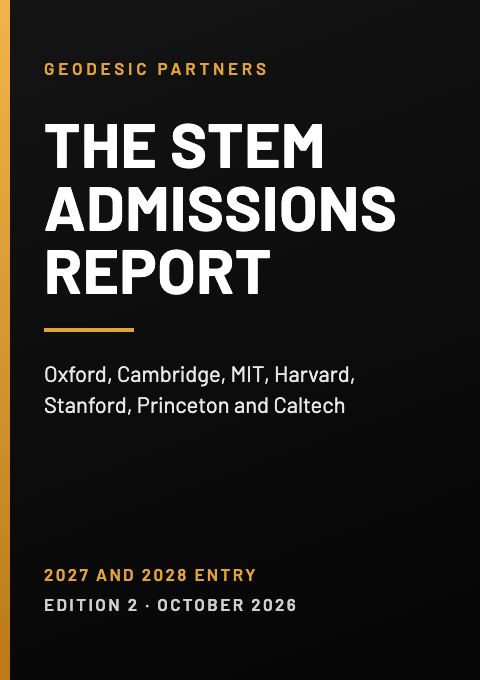
PDF · Edition 2 · £79
The STEM Admissions Report
Oxford, Cambridge, MIT, Harvard, Stanford, Princeton and Caltech: the tests, the grades, the odds by course, the deadlines, and what the degrees lead to.
Related
Oxford and Cambridge acceptance rates by course
Maths, computer science, engineering and physics, from the universities' own statistics.
Read the article → ·Oxbridge and US STEM admissions
The tests, the odds by course, the personal statement and the interview.
Oxbridge and US STEM → ·Admissions maths practice
TMUA, MAT and STEP questions with full worked solutions.
Practice questions →