Practice · Quant prep · Flow Traders
Flow Traders interview process
Flow Traders makes markets in exchange-traded products, and its graduate trader process is built around two things: fast, accurate mental arithmetic and a feel for how an ETF is priced against what it holds.
The process, from Flow Traders’ own pages
- Applying. A CV and a cover letter. The firm accepts applications all year round and recruits graduates on a rolling basis, with four intakes a year; only penultimate and final-year students are eligible. Source
- Maths test. The graduate trader maths test gives 10 minutes to solve 75 questions using only mental arithmetic. Source
- Interviews. A recruiter interview on business knowledge, motivation and fit; an interview with the team on experience, technical skills and knowledge; and a final interview with the Head of Trading and team members. Source
- Training. Graduate traders start with a three-month training programme in Amsterdam, then a team project, then a trading desk. Source
What candidates report
Candidates describe the online test as mental arithmetic with number sequences, and a final case study with senior traders built around pricing an ETF against its basket and spotting an arbitrage.
What Flow Traders states it pays
Flow Traders does not state figures in its adverts; they describe a base salary and a discretionary profit share. Pay at firms that do state it is in the Quant Careers Report.
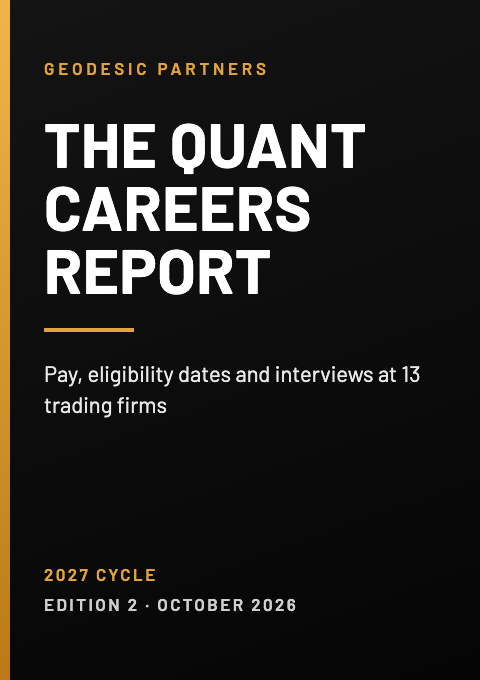
PDF · Edition 2 · £79
The Quant Careers Report
Flow Traders’ process step by step and the pay it states in its adverts, side by side with 12 other trading firms, plus when to apply and five timed practice papers with worked solutions.
What Flow Traders is testing
75 questions in 10 minutes is eight seconds a question, so the test rewards the shortcuts more than raw speed: rounding and correcting, fractions by heart, and skipping what you cannot do quickly. Practise in the real format until the pace feels ordinary.
The later rounds test whether you understand what the firm trades. Know how an ETF's price relates to the value of its holdings, what creation and redemption do, and why a leveraged ETF drifts away from a multiple of its index over time.
Six practice problems
Written by us to match the types Flow Traders is publicly reported to ask. None is a copy of any question Flow Traders has used.
-
An ETF holds three stocks with weights 50%, 30% and 20%. Today they return +2%, −1% and +4%. What does the ETF return, before fees?
Show the answer
+1.5%
A portfolio's return is the weighted average of its holdings' returns: 0.5 × 2 + 0.3 × (−1) + 0.2 × 4 = 1 − 0.3 + 0.8 = 1.5%. Doing this in your head, weight by weight, is exactly the arithmetic an ETF trader runs all day.
-
An ETF's net asset value is 100.00 and it trades at 100.15. What is the premium, and what trade closes it?
Show the answer
15 basis points; buy the basket, create units, sell the ETF
The premium is 0.15/100 = 0.15%, or 15 basis points. A market maker buys the underlying stocks, delivers them to the issuer for new ETF units, and sells those units at the higher price, earning 0.15 per unit before costs. Doing so pushes the ETF price back towards its value.
-
An index rises 10% one day and falls 10% the next. What does a fund returning twice the index each day do over the two days?
Show the answer
−4%, against −1% for the index
The index ends at 1.10 × 0.90 = 0.99, down 1%. The leveraged fund ends at 1.20 × 0.80 = 0.96, down 4%, not twice −1%. Daily rebalancing makes leveraged funds lose in choppy markets, which is why they track a multiple of the index only over a single day.
-
Without a calculator: what is 7.5% of 640?
Show the answer
48
10% is 64 and 2.5% is a quarter of that, 16, so 7.5% is 64 − 16 = 48. Splitting a percentage into easy pieces is faster than multiplying by 0.075.
-
What comes next: 3, 5, 9, 17, 33, …?
Show the answer
65
Each term is twice the previous one minus 1, so the next is 2 × 33 − 1 = 65. Equivalently the terms are 2ⁿ + 1. Sequence questions reward checking two rules, differences and ratios, before committing.
-
You make a market of 99.80 at 100.20 in an ETF you value at 100.05. A client buys at your offer. What is your edge on the trade?
Show the answer
0.15 per unit
You sold at 100.20 something worth 100.05, so you earned 0.15 per unit in expectation. Your quote was not centred on your value: buying at 99.80 would have earned 0.25. A trader asked this will usually be asked next why the quote might be skewed that way.
Practise under time
Trading first round: Ten questions across probability, puzzles and expected value, 30 minutes.
How to prepare for Flow Traders
Drill mental arithmetic daily in a timed format until eight seconds a question is comfortable, and practise number sequences separately. Learn how ETFs are created and redeemed and how their price relates to their holdings, so that a case study on arbitrage reads as familiar. Prepare a clear answer to why Flow Traders, and why market making.
Applying to Flow Traders? The strategy hour checks your arithmetic speed and market knowledge against its test and interviews. What the hour covers, £250.
Other firm guides: Jane Street, Optiver, Citadel, IMC, Five Rings, Two Sigma, D. E. Shaw, DRW, Hudson River Trading, SIG, G-Research.